top of page

All Posts

I committed to using my words and embracing this experience of dissociative integration nearly three orbits ago. Since then, I have circled myself like a hawke. I now notice every time I hold my breath, stand frozen, feel dysregulated, withhold, withdraw, or become unable to tolerate connection altogether.


These are not random behaviors. I developed these physiological skills in environments where I had little or no autonomy. At the time, they functioned as control. Now, outside of those environments, they show up as stress responses that no longer serve me.


I am learning that control is a physiological trap house, not my potential.


I am also becoming aware of how unfamiliar it feels to be seen or heard, and how my body still reads being noticed as something threatening, eliciting a freeze response.


When Safety And Threat Come From The Same Place

Disorganized attachment feels like convincing myself that people are inherently good, but never being able to fully believe it.


Research supports this contradiction.


When harm comes from a caregiver, especially in extreme cases, it can disrupt development in lasting ways. Betrayal trauma theory explains that individuals may suppress awareness of harm to preserve necessary attachment relationships (Freyd, 1996). Attachment research shows that when a caregiver is both a source of safety and threat, it can lead to disorganized attachment, which is associated in adulthood with emotional dysregulation, relationship instability, and conflicting desires for closeness and distance (Main and Solomon 1990). Chronic exposure to threat also impacts the nervous system, increasing the likelihood of hypervigilance, dissociation, and trauma-related symptoms (van der Kolk 2014).


I feel this in real time. I want a connection, but I cannot fully settle into it.


Losing Autonomy, Losing Awareness

Without autonomy, you lose a lot. The first thing you lose is the freedom to say, “This is not ok.” Then you lose awareness that something is not ok at all.


This is where internalization begins.


Psychological research shows that when individuals depend on caregivers for survival, harmful dynamics can become internalized in ways that obscure distress. Children are biologically driven to maintain attachment, even at the cost of their own perceptions (Bowlby 1969). When it is unsafe to express discomfort, people often engage in self-silencing, gradually losing both language and awareness of their experience (Jack 1991). Over time, external pressures become internal beliefs, shaping identity and behavior (Deci and Ryan 2000).


I did not just lose my voice; I became fearful of it before losing the awareness that I had one at all.


Love, Control, And Settling

To be loved is to be seen, but also to be changed. One root of my compartmentalization has been the fear of being seen. Not being seen kept me safe. Now, it just keeps me the same.


Being loved by the unavailable has been equivalent to life as an animal outside on a leash. The animal's capacity is reliant on the owner, who keeps it on a leash so they do not lose it. The animal is neglected in the distance of its owner because no one is present to respond to the animal's needs. When the animal attempts to meet its own needs, even by protest or escape, the owner reinforces restraints. Owning the animal, not caring for it, is enough to satisfy the owner's image of themselves. Rather than release the animal to a more satisfying life, the owner insists the leash is love.


I only know ambiguous love. Love that requires me to stay small, manageable, and non-threatening.


By the age of five, I had already been abandoned multiple times by my mother. I had undergone three major organ and reconstructive surgeries. I experienced homelessness and was exposed to sex work, drug trafficking, and criminal behavior. My primary caregiver was incarcerated. I was separated from both of my birth parents and siblings, moved between states, and changed schools multiple times in kindergarten.


No one asked me how I felt about any of it or helped me process what was happening, so I never developed the language to define my experiences. Over time, that absence shaped the way I see myself.


When Your Story Is Written For You

Instead, I was fed narratives about my experiences to recite. The consequences of innocent childhood behavior were severe enough that my reality became something I could not safely define on my own.


There is science behind this, too.


Research shows that children’s memories and narratives can be shaped by adult influence, especially in high-stakes environments. Children often look to trusted adults for cues about what is correct, and repeated pressure can alter both their responses and their recollection of events (Ceci and Bruck; Melnyk et al.). Memory is not fixed. It is reconstructive. Over time, suggested narratives can become internalized and feel personally true (Melnyk et al.).


I did not develop language for my experiences. I developed scripts.


When Survival Becomes Personality

When I was developing from a tadpole into a girl frog, I learned to compartmentalize so deeply that disconnection became my baseline.


Now, as I pay attention, I see how much of me has been operating through patterns rather than choice. The expectations placed on me were so strict that my personality became my nervous system, cycling through once necessary survival responses.


I was reacting, not expressing.


Even now, naming what I feel is something I am still learning.


Wanting Connection And Fearing It At The Same Time

I am exhausted by being alone. At the same time, my body inflames around people. It does not trust them.


Building a support system feels difficult because I struggle to stay in connection long enough to form bonds. I bond most easily with animals. I have two dogs and two cats, and lately I have caught myself wondering if bringing home another dog is unreasonable, or if it is simply an attempt to meet a very real need for connection.


Research shows that connection is not optional in trauma recovery. Social support is one of the strongest protective factors against long-term psychological harm. A major meta-analysis found that lack of social support is one of the strongest predictors of PTSD (Brewin, Andrews, and Valentine 2000). The buffering hypothesis explains that supportive relationships reduce the impact of stress (Cohen and Wills 1985). Trauma research consistently emphasizes that healing happens in connection, not isolation (Herman 1992; van der Kolk 2014).


I understand this intellectually. My body is still catching up.


Learning A New Way to Exist

I recently started somatic therapy to build language through my body instead of forcing it through my mind.


I am sitting with the discomfort of being seen. I am letting that discomfort reshape how I hold my anger and my sadness. I am learning to respond differently when I feel the urge to withdraw, especially after moments of courage.


Support has not made this process comfortable. It has made it possible.


Where I Am Now

I have been severely compartmentalized. I am attempting to understand it without abandoning myself. I want to be seen. I want a connection. I want to heal. All of that is still painful, but I am here, sober, paying attention, and that is different.


My next celestial intention is to explore primary and secondary emotions with somatic therapeutic support so I can begin organizing my experiences into feelings and rebuild the language I lost. I also want to become someone who can recognize safe people when I encounter them, and learn to trust others deeply enough to both love them and receive love in return.


Sources

  • Bowlby, John. Attachment and Loss: Vol. 1. Attachment. Basic Books, 1969.

  • Brewin, Chris R., Bernice Andrews, and John D. Valentine. “Meta-Analysis of Risk Factors for Posttraumatic Stress Disorder in Trauma-Exposed Adults.” Journal of Consulting and Clinical Psychology, vol. 68, no. 5, 2000, pp. 748–766.

  • Ceci, Stephen J., and Maggie Bruck. Jeopardy in the Courtroom: A Scientific Analysis of Children’s Testimony. American Psychological Association, 1995.

  • Cohen, Sheldon, and Thomas A. Wills. “Stress, Social Support, and the Buffering Hypothesis.” Psychological Bulletin, vol. 98, no. 2, 1985, pp. 310–357.

  • Deci, Edward L., and Richard M. Ryan. “The ‘What’ and ‘Why’ of Goal Pursuits: Human Needs and the Self-Determination of Behavior.” Psychological Inquiry, vol. 11, no. 4, 2000, pp. 227–268.

  • Freyd, Jennifer J. Betrayal Trauma: The Logic of Forgetting Childhood Abuse. Harvard University Press, 1996.

  • Herman, Judith Lewis. Trauma and Recovery: The Aftermath of Violence—From Domestic Abuse to Political Terror. Basic Books, 1992.

  • Jack, Dana Crowley. Silencing the Self: Women and Depression. Harvard University Press, 1991.

  • Lamb, Michael E., et al. “A Structured Forensic Interview Protocol Improves the Quality and Informativeness of Investigative Interviews with Children: A Review of Research Using the NICHD Investigative Interview Protocol.” Child Abuse & Neglect, vol. 31, no. 11–12, 2007, pp. 1201–1231.

  • Main, Mary, and Judith Solomon. “Procedures for Identifying Infants as Disorganized/Disoriented during the Ainsworth Strange Situation.” Attachment in the Preschool Years: Theory, Research, and Intervention, edited by Mark T. Greenberg et al., University of Chicago Press, 1990, pp. 121–160.

  • Melnyk, Laura, et al. “The Misinformation Effect and False Memories in Children and Adults.” Psychology, Crime & Law, vol. 16, no. 1–2, 2010, pp. 1–14.

  • Van der Kolk, Bessel A. The Body Keeps the Score: Brain, Mind, and Body in the Healing of Trauma. Viking, 2014.


© 2026 talkstoomuch All rights reserved.

No part of this article may be reproduced, distributed, or transmitted without prior written permission.


Property Ownership, Eviction Risk, and How to Prepare


People often assume “If I can’t find it, I’m okay”. That’s one of the biggest risk mistakes when living outside. The land being used always belongs to someone else. Who owns that land directly affects how long someone might be able to stay, how quickly they may be forced to move, and whether they will receive any notice of eviction at all.


Understanding property types and ownership helps prepare for displacement and reduces loss. This is not guidance on how to choose where to stay. It is an explanation of how different land ownership systems respond when someone is living on property without permission.


CAMPS ARE TEMPORARY! Even when a spot feels stable, it isn’t. Most unsheltered living situations last a few weeks to six months, and rarely remain stable long-term.


What Triggers Evictions

If the police are frequently showing up in camp in response to calls from the community, consider this an early warning signal.


Across all property types, the same patterns increase risk:

  • Fire hazards or poor sanitation

  • Complaints from neighbors (both housed and unhoused)

  • Domestic violence or conflict

  • High visibility (being seen often)

  • Proximity to schools, businesses, or busy roads


City-Owned Property (Medium Risk)

City-owned land belongs to the city government. It does not belong to one person. If the city takes care of it, fixes it, or makes rules about it, the city probably owns it. City land can feel stable temporarily, but evictions often escalate due to public pressure, media attention, or redevelopment timelines.


What it is:

  • Parks

  • Empty lots

  • Land near public buildings

  • Sidewalks


What happens here:

  • The city decides whether you can stay

  • Different city departments may have to agree before anything happens

  • Police may be asked to give notice or clear the area

  • The timing can change depending on complaints or political pressure


Note: City-owned land is often situated next to State or privately owned property, which can mean different risks apply in the same area.


State-Owned Property (Medium - High Risk)

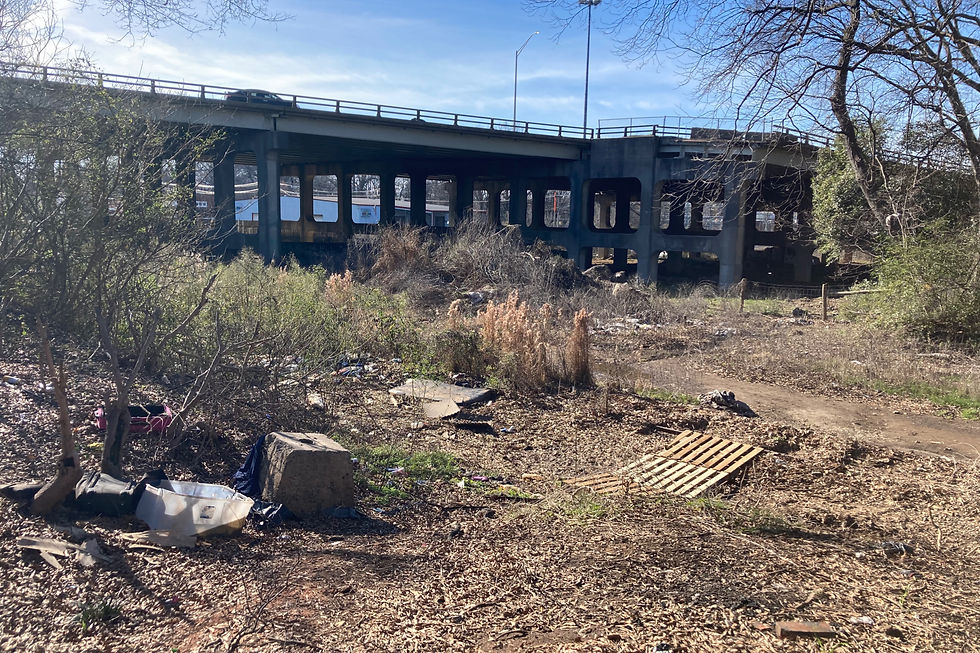
State-owned land belongs to the state government, not the city. Camps near highways or busy roads are often cleared because the state sees them as safety risks. State land is usually less stable than it looks. Evictions can happen quickly, and aggressive measures to prevent return are likely.


What it is:

  • Areas near highways

  • Under bridges

  • Department of Transportation (DOT) land


What happens here:

  • Decisions are made by people outside of the city or county where you are camping

  • Safety and visibility are often the main concerns


Note: State-owned land is often situated next to private property, which can mean different risks apply in the same area.


Utility / Railroad Property (High Risk)

Utility land belongs to companies that manage power lines, water systems, gas lines, or railroads. These areas are usually cleared because companies worry about damage, lawsuits, or safety hazards. Utility and railroad land is often one of the least stable places to stay. These areas are often cleared quickly, and efforts are usually made to prevent people from returning.


What it is:

  • Land under power lines

  • Areas around substations

  • Railroad tracks

  • Pipeline corridors


What happens here:

  • The utility company is focused on safety and fire risk

  • Police or private security will be involved

  • Railroad police are NOT city police. They work for private railroad companies and focus on protecting tracks, trains, and company property, often enforcing laws specifically related to rail safety and trespassing.


Note: Railroad companies generally control land 50 to 100 feet out from the tracks on both sides, but this varies. Beyond that distance, the land may belong to someone else, which can mean different risks apply in the same area.


Private Property (Medium to High Risk)

Private property belongs to a person or a company. Stability depends entirely on whether the owner knows and how they respond.


What it is:

  • Vacant commercial lots

  • Abandoned buildings

  • Undeveloped land


What happens here:

  • The owner decides what happens

  • If the owner does not know you are there, the camp may stay longer

  • Once the owner becomes aware, eviction can happen quickly


Using Property Search Tools to Identify Property Ownership

Understanding how to look up property ownership can help you identify who controls the land and better weigh potential risk. Most areas have a public website that shows who owns land and how it is classified. This is often called a property search, parcel lookup, or assessor website. These tools allow anyone to look up land ownership using a map or an address.


Step 1: Find the Website

Search online for:

  • “[Your county] property search”

  • or, “[Your county] assessor”

  • Look for an official government website.


Step 2: Search for the Location

  • Type in an address if you know it

  • Use the map and zoom into the area


Step 3: Select the Property

Click on the land or parcel and a record will appear. This record may include:

  • Owner name

  • Property type

  • Land use classification


The owner’s name can help you understand the type of property:

  • City name = City-owned land

  • State agency or DOT = State-owned land

  • Railroad or utility company = Utility or railroad property

  • Individual or business name = Private property


Map-Based Clues

Maps are a tool to help you understand patterns. Certain words, shapes, and features can help you identify who may own or manage the land. Even when exact ownership information is not available, understanding what kind of land you are looking at can help you anticipate potential risk.


City-Owned Land

  • “Park,” “City Park,” or “Recreation Area”

  • Large open green areas


State or Department of Transportation (DOT)

  • Land near large roads, highways, or interstates


Utility or Railroad Property

  • “Railway” or rail line labels

  • Long, straight corridors (often tracks or utility paths)

  • Power lines, substations, or utility buildings


Private Property

  • Areas with buildings

  • Clearly defined boundaries or lots


This map is an example of how land types can be identified. It is not fully accurate and should NOT be relied upon as a definitive resource. Additional research is required.

Survival Tips

Paying attention to patterns and preparing in advance are the most effective ways to reduce loss.

  • Always assume you may need to move quickly, even if a location feels stable.

  • Always have your next location in mind

  • Keep important documents in one place

  • Keep medications easy to access

  • Prepare a small “priority bag” with essential items

  • Take photos of any posted eviction notices

  • Notice signs of redevelopment, construction planning, new barriers, fencing, or large machinery


Not all property ownership is easy to identify. If ownership is unclear, do NOT assume the land is safe. Some properties are managed by agencies or companies that may act quickly, and enforcement can occur without clear warning or signage. Ownership is not always visible, but enforcement patterns still apply.


For more information about tent evictions, CLICK HERE.


© 2026 homeless.edu. All rights reserved.

No part of this article may be reproduced, distributed, or transmitted without prior written permission.


We often treat eviction notices as a formality. In reality, they are one of the most powerful tools we have to either prevent harm or create it, while directly shaping the public cost of encampment clearances.


When notice is clear, verified, and widely accessible, many camps relocate on their own, requiring far fewer public resources. When it is not, cities absorb higher costs through enforcement, cleanup, and emergency response.


Clear, verified notice is one of the most effective ways to prevent avoidable harm during encampment relocation. In practice, the quality of the notice determines whether a clearance unfolds as a controlled process or results in loss, conflict, and trauma.


When communication is informal, unclear, or unverifiable, confusion increases, stress rises, and people delay action. The outcome is predictable: avoidable property loss and heightened conflict on the day of clearance.


Establishing consistent, transparent notice practices is essential to ensuring safer, more efficient outcomes for residents, contractors, and responding agencies.


Strengthening Current Practices

Across many jurisdictions, eviction notice practices remain inconsistent and lack standardized requirements. Notices are often delivered informally, most commonly verbally, without official documentation or identifiable authority. In these situations, residents cannot verify whether a notice is legitimate, which delays preparation and increases vulnerability.


Timelines are frequently unclear, undefined, or communicated in ways that are misleading to residents, increasing the likelihood of property loss. Same-day, short-notice, or last-minute change clearances occur without a consistent minimum notice period, and enforcement dates may shift without clear communication. This unpredictability makes it difficult for residents to plan, gather their belongings, and relocate safely.


Property protection standards are similarly inconsistent. Belongings are often not inventoried, and items are discarded without documentation. In many cases, there is no clear process for retrieving or replacing personal property after a clearance.


Operational transparency is also limited. Residents are often unclear about who owns the land, who is responsible for clearing the site, whether law enforcement or third-party contractors are involved, and what to expect during enforcement. This lack of clarity allows misinformation to spread quickly, increasing anxiety, tension, and stress responses.


These are not isolated issues. They are systemic gaps that contribute to the preventable loss of identification and essential survival items, increased stress and declining mental health, rushed decision-making, and avoidable escalation.


Why Verification Matters

Verified written notice gives residents the time and information needed to pack, plan, and relocate safely. It also serves as a preventative measure, reducing the likelihood of conflict between residents and enforcement personnel on the day of eviction.


Trauma-Informed Notices and Accessibility

Providing verified, written information is not just a procedural step. It is a trauma-informed practice. Clear communication supports nervous system regulation, allowing residents to respond thoughtfully rather than react under pressure.


Eviction notices must be written in clear, simple language that is easy to understand. Many people living in encampments experience literacy challenges, and even those who can read may struggle to process information under stress. People experiencing displacement are often cognitively overloaded due to the physiological impact of functioning in a prolonged state of survival. This can slow, and in some cases freeze, the ability to process new information, form a plan, and take action.


In addition to simple language, notices should use large, readable fonts, with key dates and times prominently highlighted. Whenever possible, written notice should be paired with a verbal explanation to ensure understanding.


What an Effective Eviction Notice Must Include

A humane and effective eviction notice is built on transparency, accountability, and accessibility. When possible, notices should include official letterhead, agency branding, or other identifiable markers from the landowner or authorized authority. This establishes legitimacy and signals that the notice is credible and should be taken seriously.


Several additional components are non-negotiable:


A. Identification of the Landowner: The notice must clearly state who owns the property. This includes specifying whether the land is city-owned, state-owned, privately owned, or controlled by entities such as railroads or utility companies. Naming the landowner confirms the authority behind the request to vacate.


B. Identification of the Appointed Authority: The notice should clearly identify the agency or organization responsible for enforcing the eviction. In many cases, this is law enforcement acting on behalf of the landowner. If another organization, such as a nonprofit, is communicating the notice, that relationship must be explicitly stated. Clear designation of authority reduces confusion, limits rumor escalation, and prevents misinterpretation of informal warnings.


C. A Clear Timeline to Vacate: A defined timeline is critical. A minimum of seven to ten days’ written notice is widely considered reasonable and allows residents to make informed decisions. The notice must include the exact date and time of clearance, as well as the total number of days provided to relocate. Without this clarity, residents may not plan to leave at all, or may leave temporarily for daily needs and return to find their belongings removed.


D. Identification of the Clearing Entity: Residents should be informed that heavy machinery may be used to carry out the clearance so they can anticipate potential safety risks and remove themselves and their belongings in advance. The notice should state whether third-party contractors are involved and whether law enforcement will be present. If compensation or relocation assistance is available, it should be clearly stated.


E. A Contact Person for Questions: Providing a specific point of contact reduces anxiety and supports informed planning. The notice should include a name, phone number, and, if possible, an email address. This contact should be prepared to answer questions about timelines, property retrieval, available services, and storage options.


F. Signature: A signed notice increases accountability. It should be signed by the landowner or the officially appointed authority responsible for enforcement.


When and How Notice Should Be Delivered

Timing and delivery matter. Residents are most likely to be present in their camps during the late afternoon or early evening, after food distribution has ended.


Notice delivery should account for daily patterns, including times when residents may be away accessing food, charging devices, or attending religious services. Overnight or early-morning distribution should be avoided. Residents should also be given a clear opportunity to ask questions at the time of delivery to ensure the information is understood.


Policy Recommendations

Standardizing eviction notice practices is a practical and cost-effective way to reduce harm. Municipalities and landowners should adopt clear, consistent requirements that include official identification, named authority, a minimum seven to ten day notice period, accessible contact information, and defined property retrieval protocols.


Standardization protects residents, contractors, and agencies while reducing downstream public costs associated with conflict, emergency response, and lost property. It creates predictability, improves coordination, and leads to safer, more controlled outcomes for everyone involved.


For more information about identifying property types, CLICK HERE.


© 2026 homeless.edu. All rights reserved.

No part of this article may be reproduced, distributed, or transmitted without prior written permission.


bottom of page